Thursday, August 17, 2006

Moons Over Iridia


Well, I’m a little late with this, but this past Monday, blogfather John Scalzi challenged people to present their favorite space picture from NASA as his “Monday Photo Shoot” challenge. For this one, I’m going to reveal a certain detail about the fantasy world my wife and I write about for our book The Last VanDaryn.

Our world of Iridia differs from Earth in that it has two moons. One moon looks much like our own, but the second one has an amber glow to it. Two years ago, while playing around on the NASA website, I found two pictures of the moon I really liked. I put the two images together as a single shot of Iridia’s moons. I have this on my computer at work, and I’m amazed at how many people comment on it. From a graphic artist point-of-view, I now look at this and see several ways in which I might have made it look better, but I still enjoy it a lot. Probably why I’ve not bothered to fix it.

Frank's Beach Blast, Episode III


Monday, August 14, 2006

Sunday, August 13, 2006

Saturday, August 12, 2006

WORDSLINGERS: David L. Robbins


One of Random House’s biggest thriller novels this summer belongs to a friend of mine. This past May, I offered a review of The Assassins Gallery by David L. Robbins. The novel offers an interesting what if regarding FDR and the end of World War II. What’s ironic is that this isn’t a book David had planned to write.

This past Tuesday, Richmond’s local independent bookstore Fountain Bookstore celebrated the release of The Assassins Gallery. David spent some time discussing what led him to write this book and read the opening scene of his book.

David’s past works are made up mostly of World War II epics. He’s not one for light reads. His books include major conflicts such as the Battle of Kursk (The Last Citadel), the race for Berlin (The End of War) and the Allied invasion of France (Liberation Road). After finishing Liberation Road, David set his sights on another epic. His plan was inspired by the novel Exodus by Leon Uris. David wanted to take Uris’ idea and write about the birth of Israel. Only David wanted to do it from the point of view of an Israeli assassin. At a lunch with his editor, he pitched the idea. “They were like, ‘That’s a great story. You’re the perfect writer to do it… but no one would buy it’.” David was floored. “I asked, ‘So what do you want’?” The answer might not surprise many of you: they wanted another Da Vinci Code.

At first, David considered sticking to his artistic guns. A few days later, he was in Boston and vented by kicking pigeons (he spent a brief moment explaining that if you’re patient enough, you can sneak up on a pigeon and kick it… I think this is the Boston equivalent to cow-tipping; still not sure if he was serious) when the premise for The Assassins Gallery came to him. “Every time a president dies, there are theories that he was assassinated.” For this book, he chose the era he knows best, World War II. “I took the last months of his (Roosevelt’s) life and used his exact itinerary. I changed nothing.” David then looked at Roosevelt’s schedule within those last three-and-a-half months as if he was the assassin and figured out how he would get in and make the kill. Even though The Assassins Gallery isn’t the book he’d originally wanted to write, you can tell by the way he discusses its origins that he still loves it much like a father who avidly loves a daughter, even though he originally wanted a son.

David is Jewish and his family line descends from Russia, and you can easily see how these two elements influence his work. The Last Citadel offers a courageous family of Russians caught in “the largest armored engagement of all time.” David argues that people who think America won World War II discount Russia’s numerous victories against Germany. His Jewish background definitely shows itself within Liberation Road in which one of the main characters is a military chaplain who is a rabbi. An interesting fact about military chaplains David presented at the event at Fountain Bookstore: a much greater percentage of rabbis than chaplains from any other faith were also uniform soldiers during World War II.

Other Books by David L. Robbins:


David’s next book, The Betrayal Game, offers his first sequel. His hero from The Assassins Gallery, Mikhal Lammeck, returns and finds himself in the midst of the Bay of Pigs invasion of Cuba. You can expect that book to come out next summer.

One of my favorite questions to ask of any writer is, “What are you reading?” When asked, David said he was reading a book from George MacDonald Fraser’s “Flashman” series. I hadn’t heard of this series, even though it’s quite popular. The books tell the story of English soldier Harry Flashman who, despite being a coward and a drunkard, manages to find himself plunged into the action of many historic battles. That he achieves fame as a hero is the punch line to these stories as all the people who witness his cowardly actions typically die before they can out him for a fraud. The books are historically accurate in as far as these battles did occur and Fraser does nothing to alter their outcome. Basically, Flashman is the polar opposite of Richard Sharpe from Bernard Cornwell’s historical action series.

Monday, August 07, 2006

WORDSLINGERS: J.A. Konrath


This “Wordslingers” entry marks a first for “The Wildcat’s Lair.” For this author interview, I actually met with the subject in person. In the middle of his 23 state/68 day book tour, mystery writer Joe “J.A.” Konrath stopped in my hometown of Richmond, Virginia.

Joe’s first novel in his “Lt. Jacqueline ‘Jack’ Daniels” series was published in 2004. That book, Whiskey Sour, landed him a three-book contract with Hyperion. He fulfilled that deal this past July with his third book, Rusty Nail. Fans will get plenty more of Joe’s mixed concoction mysteries. Last year, he signed on for three more books about Jack Daniels’ investigations, which are made from one-part comedy and one-part thriller.

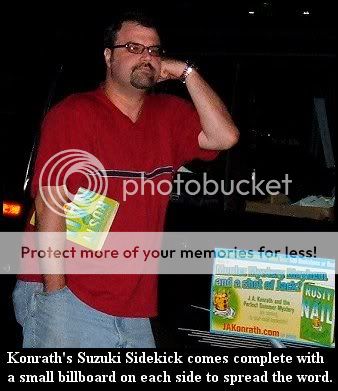
Joe joined myself and my fellow aspiring writer (and blogger-extraordinaire) Patrick of “Patrick’s Place” and “A Stop at Willoughby” for dinner this past Sunday (You can read the blog entry with Patrick's impressions here). Joe arrived in Richmond a few days behind schedule, but he didn’t look too road-worn from the many miles he’s driven in his black Suzuki Sidekick. His tour started a little more than a month earlier in Phoenix, Arizona, at the first ThrillerFest held by the International Thriller Writers. Patrick and I hooked up with Joe outside the Books-a-Million just a few blocks from my house and headed straight for the Asian Grill, one of my new favorite chinese restaurants.

Patrick and I were both a bit apprehensive. Yes, we’ve ventured quite a few times to Joe’s blog, but you just never know what kind of person you’ll find face-to-face. It didn’t take long for us to realize that we didn’t need to worry. Over inexpensive, oriental cuisine, Joe proved a rather straight-to-the-point kind of guy but without being abrupt. His expression didn’t change much, and in this dry manner, he easily switched back and forth from discussions on the publishing industry to some great one-liners. I could see how a guy like this could walk into a bookstore, unannounced, and instantly make friends with the booksellers and customers. His webpage for this tour, which calls for stops at 500 bookstores (likely more), describes these stops as “the publishing equivalent of a drive-by.” The strategy is simple, make strong impressions on everyone he meets to generate as much word-of-mouth as possible. Having been a former bookseller, I know just how much of a difference it can make when the writer of a book on my store’s shelves is more than a picture on the cover jacket.

Joe wrote nine, unpublished books before he started work on Whiskey Sour. I asked Joe about those unpublished books, thinking back on a few on the many unpublished books I’ve written during the past fifteen years (many of which I hope never see the light of day). Is he glad those books aren’t published? He never really said he was glad, but he didn’t express any regrets either. “That it took so long (to be published) probably made me appreciate it more,” he said. “If I’d been published when I was younger, I’d have probably had a sense of entitlement.” Joe is one author who carries the majority of the promotional weight for his books on his own shoulders. You’re more likely to find mid-list authors bemoaning the lack of promotion and support from their publishers. You need only look at Joe’s website, his blog and the tour which brought him to a dinner table with me and Patrick to see he doesn’t expect success handed to him.

Perhaps one of the most interesting anecdotes he offered involved a pair of tattoos. After writing his first six books and still unpublished, Joe was close to giving up, but his wife talked him out of it. She told him she wanted to buy him something, a tattoo. “That’s a very white trash thing for you to do, honey.” He said this to us with a laugh as he recounted the tale of the sad face tattoo on his right shoulder. That tattoo offered him a challenge to keep going, and when he sold his first book, he celebrated that success with a second tattoo, a smiley face on his left shoulder.

During dinner, Patrick and I asked how he managed to get any writing done while on the road. To our surprise, Joe said he wasn’t writing anything. He employs a strategy that’s not unlike the infamous NaNoWriMo which challenges would-be-writers to punch out a fifty thousand word book in the thirty days of November. Only in Joe’s case, he does his own annual, one-man NaNo challenge during the shortest month of the year. He doesn’t enter into February unprepared, though. His publisher requires an outline of the book he plans to write, which in itself can run as long as forty pages. “I just fill in the dialogue and the action.”

Books by J.A. Konrath:


Perhaps the most important thing Joe had to say was a painful truth about the publishing industry. “It’s a business.” There’s more to getting published than a well-written book. He told us about his notebook filled with more than four hundred rejection letters and his first agent who only pitched Joe’s work to two publishers in a span of nineteen months. His blog and website have both sported the statement, “There’s a word for a writer who never gives up: published.” After talking with Joe about his career, I realize that’s his one-sentence biography.

Sunday, August 06, 2006

Page


Well, today I make good on my full introduction to Page, my pet dog. She came very close to being the mascot within my blog, but such was not to be. Let’s face it. The irony of a dog mascot would have been great in a blog named “The Wildcat’s Lair.” Still, Page suffers one major fault that would hurt her place in the limelight. She hates having her picture taken.


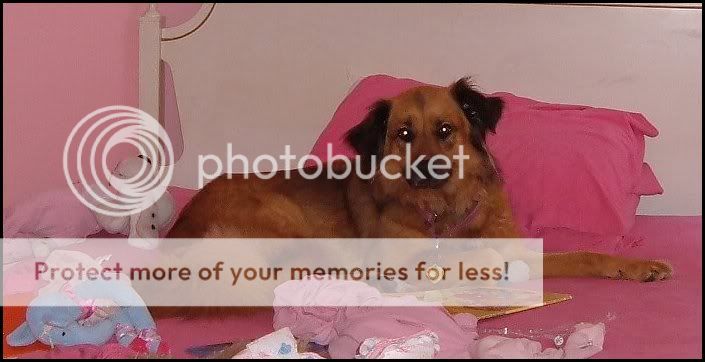
This past Friday, Page made her comic strip debut in Frank’s many adventures, and it’s not by chance that she makes that appearance while underneath the bed in my bedroom. This spot happens to be her favorite place, I think. At night, she crawls under the bed and curls up to sleep. She’ll do this during the day, too. As it happens, Page also loves to nap on my daughter’s bed during the day, but this is only if the kids aren’t in the house. Otherwise, my six-year-old daughter and four-year-old son will pester her mercilessly. To get the picture of Page on my daughter’s bed required something of an ambush. I might add, Page was not pleased with me when the flash went off. Making it up to her required ample amounts of petting and spoken endearments such as “Good dog!”
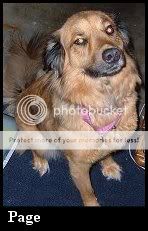
There has been at least one time in which Page proved herself a willing model. I had been taking pictures for one of Frank’s comic strips, so I had the camera out. Page walked over, sat down at the corner of the desk and started pawing at my arm that happened to be holding the camera. At first, I thought she simply wanted me to pet her, but she became more insistent. Sure enough, I raised the camera for a picture, and she didn’t try to hide. She just sat erect and posed. Even after the flash went off, she didn’t make a break for it. She stayed there and curled up on the floor. Not sure what got into her that day, but this is one of my favorite pictures of Page.

Now, let’s get to Page’s name. While I think Page is a perfect name for a dog living in a house with two writers (me and my wife), my son actually named her by accident. A year ago, we went looking for dogs and took the kids along. We wanted to make sure the dog we found would be child-friendly and one the kids weren’t scared of. The first dog that we nearly got was named “Peach.” We acted too slowly to get Peach, but a few days later, we found Page. Her name at the time was “Deja,” and while that’s a fine name, we still felt the need to give her a name of our own. As we tossed about names, our son was still thinking about Peach. He would slip up and try to call our new dog “Peach,” but it came out more like “Page.” As soon as I heard him say it, I knew that was the name.

It’s been a year since Page first joined our family, and I have to say I’m glad we got her. I wasn’t so keen about getting a dog, because I’d had one for my entire childhood and early teen years. I still can cry when I think about that furry little pikka-poo. My wife talked me into getting a new dog, though. I haven’t regretted caving on this one.

As it happens, this entry coincides with a “Weekend Assignment” about cats and dogs by the Blogfather himself, John Scalzi. The assignment: Cats vs. Dogs; choose which you prefer and tell why.

This might shock a few readers, but I prefer dogs. Yes, it’s true. My nickname might be Wildcat, but I’m just not a cat person. The only reason I’ve ever even owned any cats is because of my wife, but we no longer have any cats (and I don’t miss them). I consider cats sneaky, little, evil beasts that are one gene away from true “hell spawn.” Okay, well maybe I don’t hate them quite that much, but I just can’t abide the smell and those nasty litter boxes. We had cats when my wife was pregnant both times, and being stuck with months of cleaning that litter box by myself was most unpleasant. Yes, nothing close to the horrors of pregnancy and childbirth, I know, but that doesn’t mean I have to pretend I enjoyed it. Then there’s the attitude… or rather the “cat-titude.” Cats think they know darn well who the owner is: the cat. I just can’t stand a small furry creature treating me like a servant or a second-class citizen in my own home. Thank you, I have two children for this; I don’t need a pet for it.

Even worse, cats just seem to love me. It’s that cat thing: they’re naturally drawn to the one person who wants nothing to do with them. Hmmm... This might explain something about Frank! Speaking of Frank, he’s the closest thing to a cat we have now, and I’m not entirely convinced my wife doesn’t consider Frank the proof I’ve finally gone off the deep end (for some reason, she doesn’t think he really exists).

Then there’s my favorite advantage to dogs: they scare the hell out of burglars and unwanted guests knocking on my door. I can’t tell you how much easier it is to close the door on a door-to-door salesman when I’ve got a dog that’s part German Shepherd barking with a determination suggesting she wants to rip out someone’s guts. Good dog!

So yes, I love my not-so-little Page, and that’s why I really enjoy finding a way to include her in the online comic strips I do with Frank. I might add that Frank is the perfect cat for me. No litter box, no demands for attention and no claws. Of course, there’s still that cat-titude problem...

Saturday, August 05, 2006

A Killer's Confession (WW? #27)


While I’m not published, I’ve killed my share of characters during the past fifteen years. Like any serial killer, I like to think I’ve improved my craft as I’ve added to the long line of literary bodies in my piles of amateur dreck. Have I any remorse for my crimes against these characters? Well, I’m not without a heart, but for now, let me focus on the reason for my killer’s confession: Jess’ latest Writer’s Weekly Question.

Writer's Weekly Question #27:
Have you ever killed one of your characters before? If so, what was the motivation behind the death?

My early attempts at killing characters were a much more forced act, poorly handled as I gave more weight to plot and less to true character development. Early drafts of a book based on my childhood super heroes, The Demon Riders, included a character fated to die. Anderson just served little purpose in my mind. Yes, I made this young man a part of the team, but he never quite worked, so killing him seemed the way to go. I wanted him somewhat to blame for his own death, making him into someone who regretted his decision for the life of a heroic adventurer (in later drafts, an analyst-turned-field agent). As I look back on this character, I realize some of the reasons Anderson just never worked. First and foremost, he was made to die. As a writer, I knew this and failed to develop him to the level I did the long term characters around him. I just didn’t see the point, and I suspect that’s why his death just never really carried the impact that it should have in those early drafts.

There’s a lesson there, and while I think I’ve subconsciously learned from it over the years, I’ve never really analyzed it until now. Death is a dramatic event, but as a writer, I cannot effectively force it to happen any more than I might force a character to commit an act that isn’t in keeping with his or her personality.


I’ve often heard other writers make the comment that they decided to kill a character because it simply didn’t have anything left to do within the book. This same line of thought applies to several characters within the book my wife and I are now writing together, The Last VanDaryn. I find I’m more premeditated about these “murders,” though. I’ve learned killing off a character isn’t a simple matter of saying, “Why not just have the stupid sot run through with a sword and let the main character brood about it for a page or two?” Killing off one of these characters has to make sense. After all, there are other ways to remove a character from the story that don’t demand a death.

If one is to kill off a character, then the work to make that murder matter comes from giving that character a life worth taking. He or she must be as carefully developed as any other character. Even better is to find a way to make that murder add another obstacle for the surviving protagonists. I like to think that latter detail proves very true for the characters my wife and I kill within our book. The kind of story we’re writing demands a high body count, but that only makes the demands on us all the greater. After all, if we don’t work to make each death matter, then we will only numb the reader.

Perhaps the author, out of those I’ve read, who makes the most use out of killing characters is George R. R. Martin. This past fall, I read his book A Game of Thrones, and as I think back upon that book, I am struck by his skill at employing death. I’ve heard some of his fans jokingly call the series that started in that book “Everybody You Like Dies.” There’s some truth to that, but his bloody trail includes some of the less likeable characters, too. To make it work, he employs a huge cast of characters, so that you aren’t left without a player to root for or loathe. For all his kills, I don’t know that I can think of one in which Martin failed to make that death not only appropriate and credible but an effective twist in the plot. Definitely some lessons to be learned there, and I suspect I will revisit his works given the added respect writing this entry has given me.

Friday, August 04, 2006

Page Gets Left Behind


* See the previous episode "Hello Wildcat"