Wednesday, June 14, 2006

Cat Seeing Double


Well, for only the second time since I started my blog, I’m calling it quits on a book before I’ve read all of it. Sorry to say that Shirley Rousseau Murphy’s mystery Cat Seeing Double just isn’t doing it for me. I’m rather disappointed, because the concept behind this book and series offers so much promise.

The gimmick (most every mystery series tends to have one) for Murphy’s “Joe Grey” series involves cats who can talk to humans. The three cats within the book who are capable of this only reveal it to a few humans. They don’t quite fit in with regular cats and the part of the book that addressed this turned out the most interesting part for me. Frankly, if the book had chosen to explore more of the cats’ existence and origins, I’d have probably enjoyed it more. Yes, I had no problem with the cats being able to talk. I think part of this was because the human characters come across so two-dimensional, that I was hungry for a decent character no matter what its species.

Cat Seeing Double comes rather late within the series. It’s the eighth book, and Murphy doesn’t offer much sympathy for readers who haven’t read the previous books. Within the first three pages, she names about seven characters. As if that doesn’t create enough confusion for a newbie to her series, she references events in the past, present and future all within these three pages. From a writing standpoint, it’s a big ol’ mess that leaves one wondering why an editor didn’t point out she was clearly starting at the wrong point in the book. The references to the future give away all the surprises, including the murder of an estranged husband.

Much of the book is told from the point-of-view of Ryan Flannery. Ryan would be the wife of the aforementioned husband-to-die. She’s also the prime suspect. That creates another problem for me as a reader, because with much of the book being told from her point-of-view, I felt no suspense. She’s not guilty, and I pretty much know she won’t be found guilty either. So yes, there might be the suspense of “What if she’s wrongly convicted of the murder?” Well, for that to matter, I need to like the character, and frankly, I was wishing for a double homicide instead of just Ryan’s husband. She amounted to little more than “rescue bait” within the first half of the book, which was all I could stand to read.

Ryan wasn’t the only person I didn’t like as a character. Frankly, I just couldn’t believe in many of these characters. Of all the players in Murphy’s book, the cats are not only the most interesting but the most developed. Had she ditched the mystery and focused on these cats and their lives, misfits within both the worlds of cats and humans, I’d have enjoyed this more. Of course, then it wouldn’t be a mystery novel anymore. It would be a fantasy novel.

Another element that turned me off was the overuse of one word: evil. The people behind a bombing on a wedding are called "evil" a bit too much. I’m not suggesting that the attack on the wedding isn’t wrong morally, but evil is too powerful a word. It’s not unlike the way newscasters constantly find ways of inserting the word “tragedy” into any story where someone dies and thus weaken the word’s impact when it is appropriate.

Reading Cat Seeing Double, I sense Murphy’s “Joe Grey” series has fallen into the same problem that befalls many series. The book is too caught up in the soap opera of the characters’ lives, and the mystery is shoved into the back seat. This creates a need for Murphy to do scenes from the point-of-view of characters that just don’t really add anything to the book. Most mystery novels work best with a sparse selection of POV characters. This book definitely needs that.

The mystery offers up a lot of potential holes, and I really wanted to finish the book so I could gripe about these, too. Unfortunately, I couldn’t finish, so it wouldn’t be fair for me to get into this too much. After all, Murphy might make good on these events that don’t seem to make sense within the first half. Nonetheless, much of the mystery elements feel too contrived for my tastes.

Other Books by Shirley Rousseau Murphy:


This book also suffered because of the amount of writing I’ve been doing. Murphy’s book couldn’t compete with my desire to write. I’d put it down for several days while I was busy writing, and the idea of getting back into Cat Seeing Double just made me groan. I sat down this morning, determined to finish it... but a half hour later, I found myself just skimming through the pages. I couldn’t take it any longer.

Despite all of my complaints, I’m not necessarily going to give up on Murphy’s “Joe Grey” series. The cats really do offer a lot of promise, so I might someday venture back to try the first book. After all, Murphy’s managed to make this into a successful series, so she’s obviously doing something right for some people. Besides, I might well have just stumbled upon the "dog" in the series (Sorry, the pun was just too good to resist!).

I’m also intrigued by a cat book she wrote which was strictly fantasy called The Catswold Portal. This appears to have been one of her early books, originally published in 1993, and was just re-released in paperback last year.

Tuesday, June 13, 2006

Discriminating Writing (WW? #19)


Even coming in late with an answer to Jess’ latest Writer’s Weekly Question, I’m still finding it tough to answer this one.

Writer's Weekly Question #19:
We are a society that is literally besieged by historical, political, social, and even religious upheaval and decisions due to our connection to an information driven world. Do these things impact our creative process and do our opinions concerning various historical, political, social, and religious questions show up in our products (this can be writing, or art, or other things that involve creative process)? If so, how?

I’d say there’s little doubt that my answer is “Yes.” In fact, I’m surprised by how much of my political and religious views just sneak in there when I’m writing. I was born in 1973, so I was quite a ways post-civil rights movement. Even so, I grew up in a “New South” where equality of sex and race were a never-ending source of angst despite the fact such matters were supposedly resolved in the Constitution and the courts. Certainly, the South doesn’t have the market cornered on equality issues. One need only watch a half hour of news anywhere in this nation, and you’re almost guaranteed to find some story about someone’s rights being trampled upon because of their race, sex, religious beliefs and/or sexual orientation.

I could list lots of other issues, but for the sake of keeping this entry from growing too long, I’ll focus on equality. Perhaps the most telling element to my writing where equality is concerned has to do with women. I’ve even written a previous entry bemoaning how women are treated in most fantasy novels. Women are equals. Yes, they come with their unique quirks, but we guys do, too. In the end, there truly is little a man can do that a woman can’t and vice versa. I grew up with a sister who was a tomboy. She taught me sports, not my father. I didn’t just grow up being told women were equal. I grew up expecting a woman to be my equal, and if she behaved as anything less, I just couldn’t really respect her. I can’t say that view has changed much.

If the barrage of information in the news and other media about equality influenced me in anyway, it was to make me tired of hearing about it. I can’t tell you how many times I read a story about some young woman thrust into what has typically a “man’s” title and must overcome the doubts and scorn of the men and women around her. Whenever I read these stories, I just cringe. What I love are the stories that don’t beat me over the head with these things. I’ve heard about it in the news and in my home. Guess what. I’m far past sold on the idea of judging a person based on their actions versus their genetics.

In my last rant about women in fiction, I praised Robert Jordan’s “Wheel of Time” series. The reason I enjoy it so much is that we aren’t constantly hit over the head with the stereotype of women being treated as inferior. The playing field is a lot more equal in those books, but it’s still a far cry from a perfect world. The men and women still can’t get along. The men vent about how women treat them; the women still complain about the mule-headed men, but you don’t see these women being questioned for being able to hold power. Even when these female rulers are feared, it’s not about their sex or their race. It’s fear of their power alone, not a fear of women with power.

The irony is that I’m not so much tired of the women worrying about being underestimated by men. I’m tired of the men always being treated as doubting the ability of women. There are men who think a woman is just as capable; I’m one of them. I’d rather read more about guys like that.

One of my favorite moments in Anne McCaffrey’s Dragonflight is when one of the old-timer dragonriders learns the “modern day” riders don’t let their queens fight in order to protect them. The modern rider is floored by this reaction and asks if the old-timers really allow their queens to fight. The old-timer practically laughs at him and says, “Allow?...You can’t stop them.”

So let me bring this roundabout answer full circle. Yes, I’m influenced by the information glut around me. I’m quite the sponge when it comes to that stuff, but it’s not always a matter or mimicking what I see and read. Sometimes, when I write, my goal is to take these things to the next step.

The issue of tolerance in its many forms shows up quite often within my writing. There are elements of racism, nationalism and religious discrimination throughout. I’m not so much interested in these struggles as they apply to the individual who is being discriminated against. What fascinates me is how a society must change to accept these differences and still find a way to retain its beliefs and identity.

Friday, June 09, 2006

Getting Back to Work


Since day one of my blog, I’ve made mention of The Last VanDaryn, the book my wife and I are writing together. In all the time since, one thing I’ve never done is say what it’s about. While I do think it’s important not to give too much away, I recently realized my wife and I really do need to get more practice pitching our story.

So what is The Last VanDaryn all about? For that matter, what is a VanDaryn? The story involves three main players: Squire Isabeau VanDaryn, her adopted brother Mikhael Bek and an army of the undead known as the Dymnarae. The “First” and most powerful Dymnarae has returned from eons of absence determined to wipe out the ruling family of Iridia, the VanDaryns. The one weapon capable of destroying the First Dymnarae may only be wielded by a VanDaryn, and Isabeau is the last of her line. Mikhael, a young knight, has spent his life training to destroy Dymnarae. If he can’t fend off the rest of the Dymnarae long enough for Isabeau to battle the First, then Iridia will not survive.

For those who aren’t fans of fantasy, you likely read this and go, “It sounds like every other fantasy novel.” I wouldn’t completely disagree with this. There are a limited number of stories within any genre that work, and my wife and I would be fools to venture too far from the tree. What will set this book apart from other fantasy epics is the setting and characters, as is the case with most any book. What are these unique traits to our book? Well, now that’s the stuff I can’t yet reveal, because I want it to knock readers on their arse once they read it in the book. That and I do truly feel the ideas are strong enough that others would be tempted to steal them.

One of the reasons I’ve been drawn to write this entry is that my wife and I have been working on the book with a renewed fervor this month. Since the start of June, we’ve written almost 11,000 words, to bring the total word count to more than 34,000. I still find it frustrating that our word count is not greater. When the James River Writers Conference is held this October, my wife and I want this book ready to pitch. The conference offers a great opportunity for networking, and we’d be fools to waste that chance. The catch is that we’re also busy planning the conference and each working a full-time job. Oh, and did I forget to mention our two kids? All that hardly leaves much time to write.

What’s scary is that we’d let The Last VanDaryn sit neglected for quite a while. Whenever I do that with anything I’m writing, I get terrified I’ll find myself unable to “return” to that reality. In almost every case, that’s proven an unfounded worry. Mikhael Bek is perhaps the character I’ve written with more than any other, and that idea I couldn’t get back into his head is borderline ludicrous. Still, I encounter this fear with him, too.

The material I’ve written with Mikhael in this book feels stronger than anything I’ve ever done with him, and it’s easily some of my best writing ever. You might ask, so what about Isabeau? Why don’t I say the same about her? Don’t let my statement give the impression she’s not doing well, too. Frankly, to explain that will require another journal entry. I’ll write that entry later this month, and in that entry, I’ll finally explain just how two people can write one book… or at least, how my wife and I do it.

Thursday, June 08, 2006

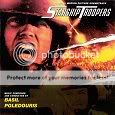
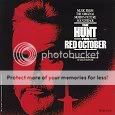
HIGH NOTES: The Hunt for Red October


As I sat down to write this entry, I was startled to realize that the score to “The Hunt for Red October” and I possibly have more of a history than I do with any other score (with the exception of “Star Wars”).

The music first found its way into my collection in 1990 as a cassette copy gifted to me by a co-worker when I was in high school. What prompted this, I can’t quite recall, but my first listen didn’t impress me, and the cassette was promptly forgotten. Sometime later, as I was in college, I bought a copy of the score on CD on a whim. What prompted that, I also cannot recall, save I was hungry for new music. This time, I loved it. In fact, I enjoyed it so much, that when I finally remembered having a cassette copy, I assumed the cassette must have been of different music. Not so. The music was the same; I suppose my tastes had simply matured.

This CD stands out for several reasons. For starters, while we’re treated to ten tracks, only two of them run longer than four minutes. Even stranger, another pair of tracks don’t break the one minute mark! As a total, the CD barely makes it past thirty minutes, making it perhaps the shortest movie score in my collection, beating out my disc to “Blade II: Bloodlust” which clocks in just under thirty-four minutes. Perhaps one of the most intriguing things about this score is that I’ve never bought anything else by its composer Basil Poledouris. My movie tastes just don’t seem to run along the same tracks as his films.

Given his name, you might think Poledouris some European composer imported by Hollywood. I know I certainly did, but this guy was born in Kansas City of all places. He’s never quite garnered the same recognition as composers such as James Horner or Hans Zimmer, but he’s marked his own place within film music and with a rather diverse set of films. He’s scored “The Blue Lagoon,” “Robocop,” “Lonesome Dove” and even “Starship Troopers,” but his most renowned work was probably for “Conan the Barbarian” and “The Hunt for Red October.”

Enough about the composer, let’s discuss the music. As wide as the composer’s musical history is, “The Hunt for Red October” offers us just as diverse a score. He successfully draws on traditional elements, such as a male choir within “Hymn to Red October,” and synthesized percussion which dominates the final track, aptly named “Kaboom!!!” The music is both somber and fun, and I’m amazed at how Poledouris accomplishes it.

Perhaps my only gripe is the quality of the CD. I’m not so much bothered by the length, as I am the sound of these tracks. Often, a piece of music will be recorded a bit differently for the CD as compared to the film version. A good example of this is “Two Wives” which accompanies one of the most intense moments in the film as the Soviet Red October performs an unexpected course correction, unknowingly risking a collision with the American submarine USS Dallas. The film version of this piece is much more intense where as the CD version is more of a lovely, contemplative melody.

Other Scores by Basil Poledouris:


At some point in the past few years, I actually got rid of this CD, because I just wasn’t listening to it that much. Within the past year, I bought it again. In hindsight, getting rid of it the first time was stupid. I think I listen to it very little because I so associate it with one of my past writing efforts. Back in college, I started a book with the working title The Bear & the Serpent. I intended it as a story told within three time periods that eventually intersect in a place where several factions of Hell’s demons meet in battle… a civil war of the damned, you might say. I wrote as much as 17,000 words before stopping, and I’ve never found the right time to go back and finish it. At the time, I felt it some of my strongest writing (a sentiment I doubt I would have for it now). For this story, I went so far as to do research, learning what I could about 11th Century Scotland and the time of Shakespeare within the rule of James I. This was most likely the first time I did any research for a book I was writing. While there are no Russian elements to this tale, I constantly listened to “The Hunt for Red October” as I worked on that book. When I hear this music, I’m hearing the mood of that book. One day, I will return to The Bear & the Serpent. Of that, I’ve no doubt, but other “loves” have distracted me. Until then, I’ll hold onto this music and put it to ample use once again, when the time is right.

Wednesday, June 07, 2006

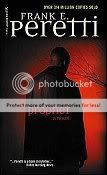
DUST JACKETS: This Present Darkness


Perhaps the most influential book on my writing was a work of religious fiction, a genre I generally find lacking. Frank E. Peretti’s book This Present Darkness was released back in 1986 and offered up one of the most intriguing interpretations of spiritual warfare.

There’s little doubt that the concept behind this book is the best part, so I’ll discuss that a bit. We’re given the standard armies of the angels and demons. Demons attach themselves to people who aren’t saved, taking advantage of their spiritual weaknesses such as lust or the like. The angels draw their strength from the prayers of God’s human followers. The greater the prayers and the greater the belief of the person praying, the more powerful the angels become. Now, the angels are by far the coolest characters in the book. These aren’t your cheezy harp-playing, diaper-wearing, little cherubs. No, we’re talking more like Navy SEALS with wings and swords… well, almost. They don’t curse, of course, and they don’t drink… Well, come to think of it, they’re more like Navy SEALS with wings and swords and Boy Scout values. Regardless, they’re pretty damn—er, darn cool.

Peretti created an intricate story for this book, another thing I liked about This Present Darkness. He almost has to, because even as we’re following the spiritual battle, we’re watching a parallel conflict within the mortal world. What’s fascinating is how Peretti takes all these separate threads and slowly ties them together. The angels can’t win their battle without the aid of the Christian faithful and vice versa. Much as I praise this plot, I honestly remember nothing about the specifics. I read this book back in high school, so it’s hard to remember much. Essentially, it’s a battle for the collective soul of the town of Ashton. At stake in the mortal world is the purchase of local Whitmore College by the shadowy Omni Corporation.

The ending is a bit tricky, maybe even a bit too saccharine and over the top. I think Peretti handled the ending to the sequel, Piercing the Darkness, better. The mortals essentially realize the demon involvement, and it just comes across a little too easy for all these people to accept it.

One thing Peretti does well is make the book move very quickly. I certainly didn’t get bored with this book. The sequel turned out even better. I do wonder about the quality of the writing, though. Frankly, I’ve found most religious fiction just isn’t that well-written. I read Peretti’s work long ago, so I obviously couldn’t bring a writer’s eye to bear on it. Unfortunately, I can say I never quite enjoyed his work beyond This Present Darkness and Piercing the Darkness. I read his book The Oath, and even though I finished it, the book just didn’t work for me. When I tried to read his novel Prophet, I couldn’t get very far into it. For Prophet, Peretti did research into how local news operations work, but speaking as a former television news producer, I just couldn’t find his interpretation credible. I had to put the book down without getting very far into it, and I’ve never felt any desire to read it since. The latter two books turned me off enough that I’ve not tried to read anymore of Peretti’s books.

Other Books by Frank E. Peretti:


As fascinating as I found Peretti’s concept within This Present Darkness, I always wanted to take it one step further. Much of my early writing was an effort to couple his idea of an invisible war between Heaven and Hell with a CIA counter-terrorism action-adventure. I don’t know that I ever succeeded in making it work, and I don’t think it was simply a matter of my writing skills not being up to the task. Part of Peretti’s secret to making these two books work is that he makes the ordinary world into a fascinating place by showing us what’s possibly happening without us ever seeing it. The more I worked on the counter-terrorism adventure tale, the less the parallel spiritual war worked. The real world battle already held enough intrigue and excitement that I think the spiritual war actually took away from it and over-complicated the plot. I don’t consider those early efforts wasted, though. They’ve given me a wealth of characters and story ideas to draw on for later works. This is probably the best praise I can give Peretti, that he inspired me as a writer and, in many ways, continues to.

Sunday, June 04, 2006

The Bear & Bogart


You just never know what will inspire you to write. Recently, mystery writer and editor Sandra Ruttan posted an entry challenging her readers to define a new genre called “Cozy Noir.” I didn’t enter this contest, but the phrase stuck in my head. I couldn’t get rid of this image of some detective bear channeling Humphrey Bogart to solve a murder.

The idea got so stuck in my head, I was compelled to get out of bed in the middle of the day (and I really needed to be sleeping, too) and punch out a bit of flash fiction with the ideas that were running through my mind. The result was something along the lines of film noir meets “Toy Story.” The main character is none other than Ted E. Bear. Funny enough, my son took my sunglasses the other day and put them on his favorite stuffed bear. I took one look and went, “It’s Ted!”

Anyway, I digress. The point of this little entry is blatant self-promotion. My short short story entitled “Unstuffed” has found its way into the latest issue of Spinetingler Magazine as one of their examples of “cozy noir.” Am I excited? Um, hell yeah! Spinetingler is also planning to publish my other short story “I am Sam,” but that’s for a later issue even though that was accepted before “Unstuffed.” There’s something oddly fitting about this goofy story, which is shorter than this blog entry, being my first publishing credit. While a lot of my writing is dark and brooding, I’m more of a goofball in real life, and this story reflects that.


So check out the latest issue of Spinetingler. You’ll find my story in the magazine’s four-pack of cozy noir tales. For all those who’ve followed my blog and my discussions about my writing, here’s your chance to get a look at some of my fiction work. The first example of many, I hope.

Friday, June 02, 2006

The Summer of God


While I think May turned out one of my better blogging months, I have to say it was one of the worst months where my writing was concerned. For a variety of reasons that could probably fill an entire blog, life was just too bloody stressful this past month. Usually, writing has offered me a refuge for tough times, but this was one case where it just wasn’t happening. I’m happy to say that things seem to be on the upswing right now, and I suspect May’s drought will deliver a deluge for June.

Even though I plan to reinvigorate my writing this month, I won’t be neglecting my lair… or should I say lairs? For now, I’m still maintaining my parallel blog on Blogger… which I think has worked out well. Last month offered me plenty of good material with my tribute to John Williams’ scores for the “Star Wars” films and “Dust Jacket” entries focused on books I read a long time ago in cities far, far away from Richmond, Virginia.

The idea of monthly themes seems to work well for my blog, and as I finish reading the offbeat mystery Cat Seeing Double by Shirley Rousseau Murphy, I plan to get rather serious for the month of June. The focus, both of the next book I plan to read and this month’s “Dust Jackets” entries will be religion. As I mentioned last month, I received a copy of an autographed advanced reader’s copy of Javier Sierra’s The Secret Supper. While the book was not inspired by Dan Brown’s infamous The Da Vinci Code, one can safely assume the publisher hopes to cash in on the strong interest in religious conspiracies that’s gripped America’s readers.

So what books can you expect to find in my “Dust Jackets” entries? Well, I’ll finally do a review of The Da Vinci Code. Despite my best efforts to the contrary, the book has found mentions aplenty within my blog. Perhaps my review will finally put that to an end (riiiiiiiiiight). The other books you can expect include End of Days (no connection to the Arnold Schwarzenegger film) by Dennis Danvers and This Present Darkness by Frank E. Peretti. I also plan to do a “Dust Jacket” on The Medici Dagger by Cameron West. The book doesn’t so much deal with religion as Leonardo Da Vinci, so this will be the “wild card” among my “Dust Jackets” for this month.


My “High Notes” entries will shy away from the religious theme, opting for a theme of their own. This month’s entries will focus on the music created for the Jack Ryan films based on Tom Clancy’s books. For those not up on their Clancy, those films include “The Hunt for Red October,” “Patriot Games” and “Clear and Present Danger.” Yes, there’s a fourth one, “The Sum of All Fears,” but I don’t own that particular score. Finances-willing, I might spare the ten dollars needed to download the entire score off of Buy.com, but I’ll have to wait and see.


Some have probably noticed Frank spends a lot of time hanging out with my son Liam. That has more to do with my son not being in school and my daughter still finishing up her school year. In the interest of “equal time,” I’ll see if I can’t let my daughter go an a little adventure with Frank this month.

As you can see, I plan to keep busy this month. I’ll also update you a bit on how things are going as the countdown to the 2006 James River Writers Conference continues. Talk about something to make me stress! As I look back on this entry, I suppose I’m selling my writing a little short, but I’ll explain why in a later entry.

Wednesday, May 31, 2006

The "Write" Time (WW? #17)


I’m late with my reply to Jess’ latest Writer’s Weekly Question, so let’s get right to it.

Writer's Weekly Question# 17:
What season do you find to be the most distracting for you as a writer? Why? Conversely, when do you find that you accomplish the most as a writer?

I really don’t know that I have a worst time of the year as a writer. Hard as I try to think of a time that’s worst for me, I just can’t find this answer. Does this mean I’m consistent year round? No, not a bit. In fact, I’ve done almost no writing at all this month. The reason has nothing to do with the time of year, though. That reason is owed more to random stress that could have struck at any time of the year.

Now, that said… I think summer might be my most productive time. I say this for a reason Jess actually highlighted as one of her distractions. Summer movies often inspire me as a writer. Since much of what I write is action adventure in nature, the summer movies fire my imagination with interesting images and concepts. When I see a movie like “Star Wars, Episode III: Revenge of the Sith,” I just get jazzed about trying to create something equally exciting. It motivates me to get writing and bring my own creations closer to completion. Perhaps it’s seeing other people bringing their visions of fantasy to life… knowing that if they did it, then so can I.

The reverse was probably true back in my high school and college days. During that time, the school year made writing a welcome reason to ignore homework. Oddly enough, going to class also inspired me to write. The creative spirit didn’t come from any success enjoyed in the classroom. My writing flourished because it was technically me being bad and neglecting my responsibilities, something every teenager enjoys. As I consider this, I have to wonder if that’s a lot of why Jess finds summer more distracting as a writer than I do.

Monday, May 29, 2006

DUST JACKETS: The List of Seven


Perhaps one of the weirdest and most interesting takes on the legendary Sherlock Holmes came from a co-creator of “Twin Peaks.” In the early nineties, Mark Frost’s first book The List of Seven was published, and the subject matter was too good for me to pass up.


The main character is Sir Arthur Conan Doyle, the physician and writer who created Sherlock Holmes and his sidekick Dr. Watson. Set in 1884 London, Doyle’s writing career has not taken off and his most noteworthy exploits are as a demystifier of the occult. With that in mind, Doyle finds himself invited to a séance to make sure a beautiful and mysterious young woman is not being hoodwinked. The séance turns into a murder, and as Doyle flees for safety, he falls into the company of the heroic Jack Sparks. Sparks claims to be a secret agent serving the British Crown. Together, Sparks and Doyle uncover an occult group of conspirators with plans for world domination, and their only lead to the dark brotherhood is a list of seven names. Doyle doesn’t quite trust Sparks, though, and the longer he stays with the supposed spy, the more he questions whether the man is all he claims.


The book didn’t seem to make the splash Frost and his publisher had hoped. There’s little doubt, they were hoping to cash in on the “Twin Peaks” crowd. According to one source I found in my online refresher course for this book, Universal Studios had planned to release a film based on the book back in the summer of 1994, but obviously, that never materialized.

I recall enjoying this book a lot. The mix of mystery and the supernatural made it a real pleaser for me in my college years. I’d enjoyed “Twin Peaks” quite a bit, even though I came in on that series late in its last season. Was it a well-written book? I’m not so sure of that. It’s been too long for me to remember much of that, but as mystery thrillers go, I was satisfied at the time. I even liked the book enough to buy its sequel The Six Messiahs. The sequel is why I question whether The List of Seven was well written. I tried to read The Six Messiahs and could never get into it. That probably had something to do with the story being set in the “Old West,” since I’ve never much cared for westerns. It’s noteworthy that a third book was never published in this series, and I think even for my part, I didn’t see much point in the characters going beyond the first book. Some stories really don’t need a sequel.

Other Books by Mark Frost:


What’s most surprising about Frost is that he has found success as a writer… but not within the strange genre that put his name on the map on television. Within the past few years, he’s published a pair of books on golf. One of these, The Greatest Game Ever Played, was recently made into a film directed by Bill Paxton. He hasn’t totally abandoned fantasy and science fiction, though. He also helped script last summer’s film adaptation of the comic book “The Fantastic Four.” Whatever you might think about Mark Frost and his work, he’s certainly proven himself a writer who refuses to be pigeonholed.

Wednesday, May 24, 2006

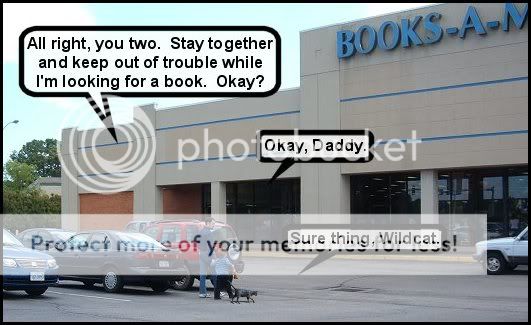
Wildcat and the "Blue Bookstore"


Well, it’s taken me more than a month to finally make good on my bet to Frank. If you’ll recall, I lost our bracket battle for the NCAA Tournament. That meant I had to read three cat-related books and take him to the bookstore for a café mocha... something I'd basically sworn to never do again after the last time I took him to a bookstore.

Frank didn’t quite get his café mocha, though. My son decided to tag along and insisted we go to the “blue bookstore.” Fortunately for me, Frank was willing to allow the concession as long as he got something with caffeine in it.


I could quickly see these two were going to get into a lot of trouble, because it was taking a long time to find what I was looking for. They were a little tired, so I let them take a nap while I kept looking.


Unfortunately, they didn’t sleep as long as I thought they would and well… you can probably guess the rest.


My search for a book was finally successful, and having found my son and Frank, we made our way to the café for something to drink.


Despite what Frank thinks about the book, my next read is Cat Seeing Double by Shirley Rousseau Murphy. The book was recommended by a friend of mine in the Ten Page Club, the writing group my wife and are part of. And yes, the cats in the book do talk to the people. Weird... but it supposedly works. We’ll see.